
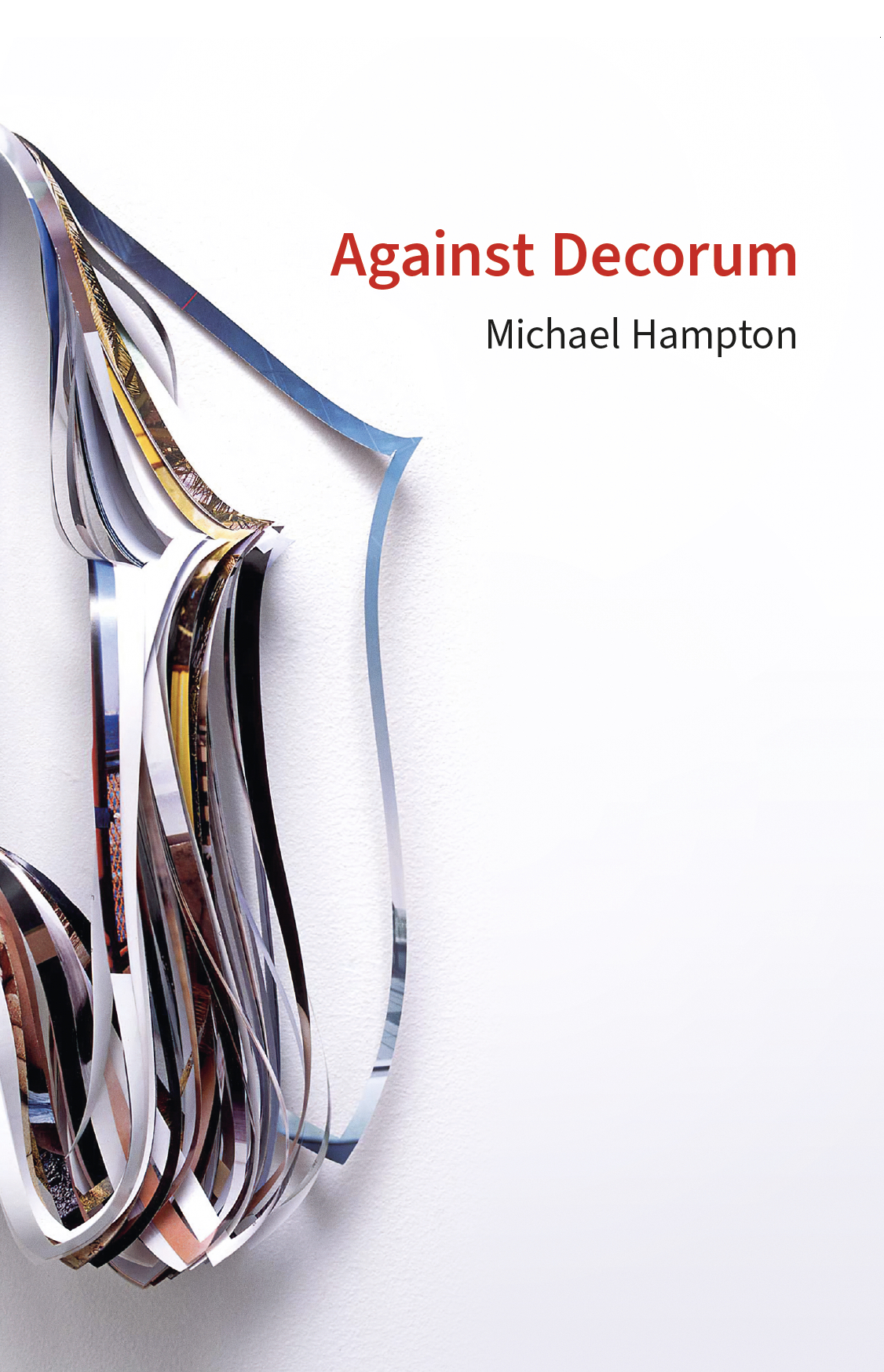
Author: Michael Hampton
Title: Against Decorum
ISBN: 978-1-907468-39-1
Year: 2022
Edition: 500
Pages: 120
Binding: Perfect
Dimensions: 235x160mm
“In Against Decorum, Michael Hampton conveys a rich, centuries-long culture of book damage. Against Decorum is an exploration of the many ways in which the physical integrity of the printed codex is put under strain. A connoisseur of the frayed, the scuffed, and the torn, Hampton describes ‘a new era of bibliographic unorthodoxy’ in which books are fallen things. To these contemporary works Hampton brings a scalpel and excises a language of time-worn use. Hampton calls these excerpts ‘gleanings’, ‘trawlings’, and ‘shards’, among other things. The result is a piling up that is a kind of poem built from a language of book damage. [
…
The discourse of book use buried in catalogues but raised to prominence by Hampton’s cutting is teeming and strange. It is a language of chipping, foxing, staining, cracking, soiling, corroding; of the tipped-in, the oxidised, the creased, and the dusty; of the torn, the mottled, the thumbed, the cropped, and the nicked. Some of the terms (‘embrowning’) are beguilingly unusual. Some of them are erotic: there is a lot of ‘rubbing’, particularly at the ‘extremities’. Sometimes books are like bodies (they might be ‘sunned’, as if on a beach in August); sometimes (‘worming’) books are a kind of food. There is a pathos in this, too, a sense that these signs of use mark the passage of time: the language of ‘grubby handling’ is (in Hampton’s words) ‘shot through with melancholy’, and Against Decorum might be read as a poem about, and composed out of, bibliographical entropy. Bibliography—literally, ‘book-writing’—is, in Hampton’s hands, cut back to a vocabulary of the ‘defective’, the ‘lacking’, the ‘fading’, and the ‘gone’.
…
What we see is that books have never not been altered, and in place of the fantasy of the pristine volume, Hampton gives us an index—that is also a poem, and is also a manifesto—of handling, of wear and tear, of water-stained pages and insect damage. Books here are in the world, on the move, not behind glass, and in this culture, no person can definitively ‘own’ a book: the book always exceeds them, and the best we can do is feel it pass through our hands.” – Adam Smyth, Professor of English and the History of the Book, Balliol College, Oxford University. (This text by Smyth is taken from the Foreword to Against Decorum and is entitled: ‘Grubby Handling’).
“Against the pristine ahistoricism of certain book collectors—who idolize the cryogenic hygiene of unchipped jackets and unclipped flaps on books unmarked and better yet unread—Michael Hampton’s study of ‘inscription in the expanded field’ revels in the afterlife of books as sites for further marking: abrasion, tear, crease, dismemberment, notation, vandalism, et cetera. Books here—whether witnesses or victims, martyrs or survivors—are recognized as special types of chronographs, in which handling marks time and records history.
Assembling a catalogue of (excerpted) catalogues, Hampton offers a distant reading that only ever focuses up close; the result is illuminating and poetic, summoning an atmosphere of bibliographic melancholy. But the story here is far from tragic, and Against Decorum chronicles the unpredictable miracle of the codex: like human bodies, books are simultaneously unbearably fragile and unimaginably durable.
Moreover, this bibliographic attention recognizes literature not as abstract ‘works’, or even undifferentiated editions, but rather as a constellation of singularities illuminated in unique, material copies. The implications for literary history and theory are broader still. If we often imagine reading as a disembodied and intellectual activity, here are the unforgettable reminders that every contact leaves a trace (even, as Matthew Kirschenbaum has argued, for digital literature)—and that every act of reading is a moment of contact. Handle carefully.” – Craig Dworkin, Professor of English, University of Utah
Michael Hampton is an independent writer and specialist in artists’ publishing and ephemera. His study and theoretical supplement Unshelfmarked: Reconceiving the artists’ book (Uniformbooks, 2015), proposed a new canon and timeline for the genre. From 2009 to 2019 he was a regular exhibition and book reviewer for Art Monthly. Hampton’s critical writing has appeared in a wide range of publications: Blue Notebook, Soanyway, 3a.m., White Review, Invert/Extant, Denizen of the Dead, Fortnightly Review, Penguin Collector, Geschichte etc. His essay Beyond Walter Benjamin’s Paris & Kenneth Goldsmith’s New York (Ma Bibliothèque, 2018), parsed contemporary geopolitics. In Against Decorum he shows, through the strategic use of found material, how entropy affects the DNA of books, transferring the Metzgerite concept of autodestructive art to the bibliographic realm, surveying the kinetic relationship between eye, hand, text and page at the site of active readership.
Book Launch:
4pm, 17th June 2022
Featuring a reading by Anat Ben-David & Sean Ashton MayDay Rooms
88 Fleet Street, London, EC4Y 1DH
Against Decorum
Portfolio
-

Against Decorum

-

Inscription: the Journal of Material Text – Theory, Practice & History, vol. 2 on ‘holes’
-

Inscription: the Journal of Material Text – Theory, Practice, History, vol.1 ‘beginnings’
-

13 March 1911
-

Def.
-

Weaving Language
-

Catch-words
-

On the Literary Means of Representing the Powerful as Powerless
-

Perfect Love
-

Last Words
-

Reading Matters
-

Eulogy for David Antin in English English
-

Calvariae Disjecta: The many hauntings of Burton Agnes Hall
-

Reading as Art
-

Twelve Erroneous Displacements and a Fact
-

Cartography for Girls
-

Correcciones
-

Magritte for Cheerleaders
-

(Expanded Second Edition)
-

Nothing: A User’s Manual
-

Getting Inside Simon Morris’ Head
-

Spanish Do or DIY translation
-

German Do or DIY translation
-

The Nabokov Paper
-

I, Sparkie
-

Dis Manibus: A Taxonomy of Ghosts from Popular Forms
-

Learn to Read Differently
-

Of the Subcontract, Or Principles of Poetic Right
-
Page 141 2
-

Jaap Blonk, Poet-in-Residence at Shandy Hall
-

Garry Neill Kennedy, Artist-in-Residence at Shandy Hall
-

Freud on Holiday: Appendices III and IV, plus full wrapped set
-

Pigeon Reader
-

Enchiridion: three manoeuvres by Tim Brennan in NE Scotland
-

Do or DIY – exhibition 2
-

Do or DIY – pocketbook
-

Do or DIY – exhibition 1
-

Sucking on Words poetry readings
-

The Man Booker Shortlist Quiz!
-

Reisen II
-

Exercise in Pathetic Criticism
-

The Persons
-

Freud’s Weather
-

Howl #16
-

Have a Peck at Perec, tote bag
-

Frued’s Dining
-

Bibliomancy: Lotsa Fun For All The Family
-

The Forgetting of a Proper Name
-

Summer School for Literary Perverts
-

Poetry Readings in Leeds
-

Instruction Manual
-

information as material residency
-

Re-Writing Freud app
-

Getting Inside Jack Kerouac’s Head
-

Making Nothing Happen DVD
-

The Perverse Library
-

The Perverse Library exhibition
-

Robert Fitterman & Kim Rosenfield Residency
-

Freud and the Gift of Flowers
-

Reisen I
-

THE IDEOLOGY OF DAVID CAMERON’S PARTY
-

Marie-Josée Jean & Klaus Scherübel Residency
-

THE DIE IS CAST
-

He
-

Historico-naturalis et Archaeologica ex Dale Street
-

Craig Dworkin Residency
-

The Voice and Nothing More: an academic mash up
-

Spinning Vol. II: De-Centering the Self
-

A Perverse Library
-

An Agent of the Estate
-

A Disturbance of Memory
-

Iam Survey Exhibition
-

A One Day Bookshop for Experimental Literature
-

Kenneth Goldsmith Residency
-

sucking on words DVD
-

Historia Abscondita (An Index of Joy)
-

L’esprit d’escalier
-

We Report Here
-

Deciphering Human Chromosone 16: Index to the Report
-

Flatland: A Romance of Many Dimensions
-

Reading the Remove of Literature
-

Thesaurus Scienta Lancastriae
-

Freud Dreams of Rome
-

Re-Writing Freud
-

The Answer to the Question
-

Royal Road to the Unconscious
-

bibliomania 2000-2001
-

Interpretation vol.I
-
Interpretation vol. II
-

bibliomania 1998-1999
