
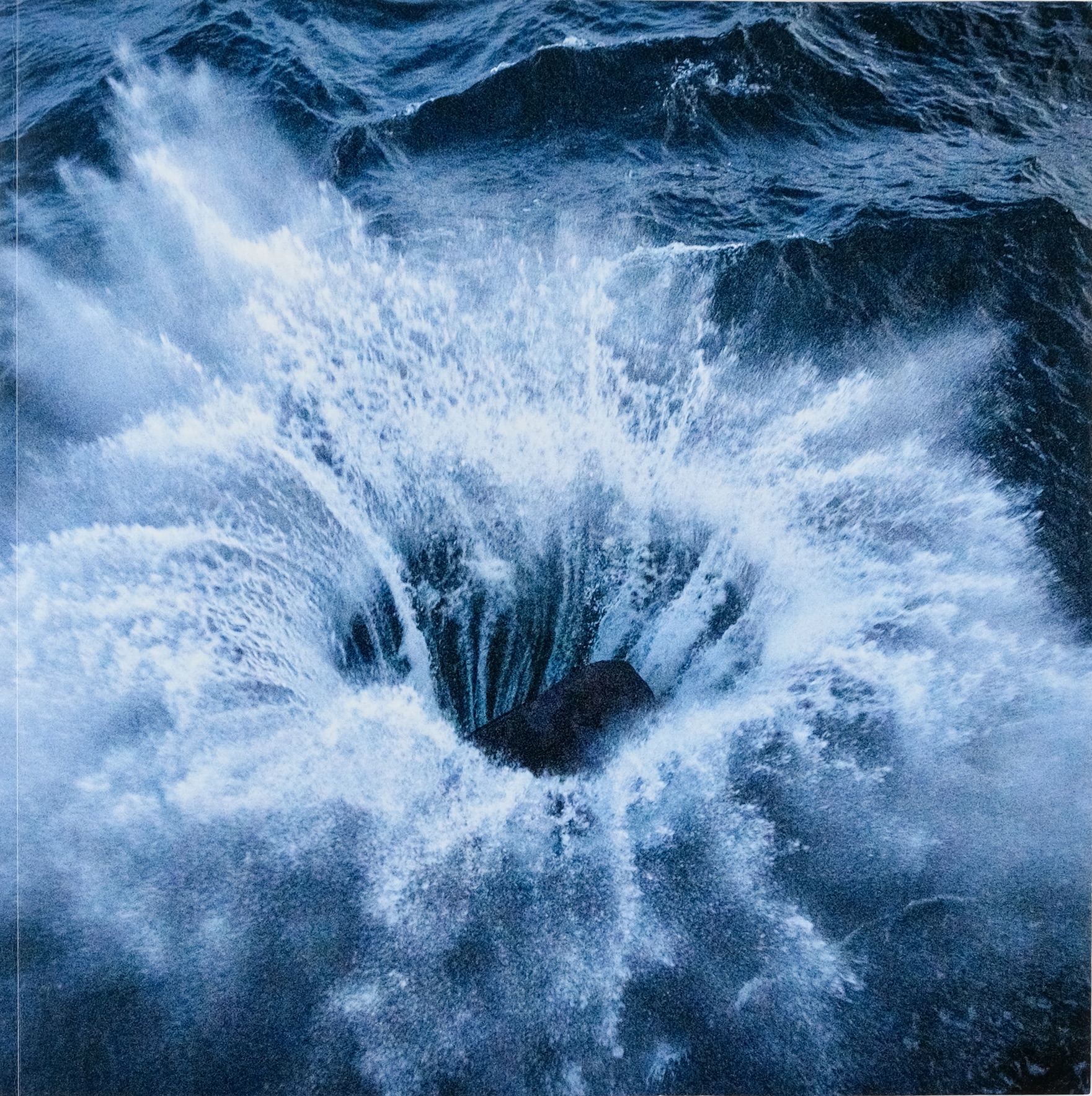
Title: Inscription: the Journal of Material Text – Theory, Practice & History, vol. 2 on ‘holes’
Editors: Simon Morris, Gill Partington & Adam Smyth (editors)
Publisher: Information as Material Ltd. (iam) in partnership with Leeds Beckett University
Price: OOP
Inscription (Print) ISSN 2634-7210
Inscription (Online) ISSN 2634-7229
Year: 2021
Edition: 500
Pages: 180 pages plus 4 page cover
Binding: Fold, gather, thread sew and draw on cover.
Illustration: Colour throughout
Dimensions: 317x317mm
Launch event for issue 2 of Inscription: Wednesday 20 October 5-8pm
Location: No Show Space, 39 Temple Street, London E2 6QQ
Inscription: the Journal of Material Text issue 2 performs three functions:
First, this issue is themed around ‘holes’ and explores how holes operate within material texts. What is revealed if we focus not on the surface of the page but on its perforations and gaps? What can these lacunae tell us about how texts were used in the past, and also their meanings in the present? Scholars of the material text have focused on the physical characteristics of the page, poring over the details of paper stock, parchment making and book construction. But in the process they are also confronted routinely with holes — needleholes made in order to stitch pages together; tunnels made by bookworms and other pests; large irregular gaps as a result of flaws in the animal hide; pinpricks used by medieval scribes to mark out the layout of a manuscript page. Historically, the text is riddled with holes and more recently has been subject to numerous avant-garde artistic experiments including being shot, perforated, cut, excised and hole-punched. Inscription 2 tunnels deep into these holes!
Second, Inscription is itself an artist’s book that mediates on the long and teeming history of journal publication. Working with Fraser Muggeridge studio, we’ve meticulously designed each of our articles to follow the typography and layout of a different historically significant journal: from T. S. Eliot’s Criterion to the schlocky pulp print aesthetic of mid-century science-fiction magazine Amazing Stories; from the 1970s political activism of Spare Rib to the arch, media-savvy innovations of Art Monthly – to name but a few. What is the effect of this kind of celebratory visual quotation?
Third, Inscription is an interdisciplinary space where art and literature converge. The journal’s theoretically aware, trans-historical, and cross-disciplinary remit breaks with the conventions of academic ghettoization, creating connections between areas that have much to say to one another – bibliography, media theory, conservation, the history of the book, museum studies, art, design, curation and artist’s book studies, for instance – enabling wide-ranging conversation and unexpected juxtapositions. Inscription sets the agenda for the next phase in the study of material texts.
Issue 2 is all about ‘holes’, and includes papers by Deirdre Lynch and Craig Robertson, Heather Wolfe, James Misson, Louis Lüthi, Paul Reynolds, Aleksandra Kaminska and Juliette De Maeyer, Galina Oustnova-Stjepanovic, and Michael Marcinkowski. Artists and academics present their thinking on ‘holes’ through text, image and the spoken word.
Issue 2 also features commissioned art from Fiona Banner, Erica Baum, David Bellingham, Christian Bök, Dianna Frid, Kendell Geers, Miranda July, Carla Nappi, Harold Offeh and Carolyn Thompson.
Inscription also comes with its signature extras – including a vinyl LP, print editions, bookmarks and more.
If books are one-off heavy-weights, then journals have a lightness that encourages risk, and a seriality that creates connections and personality across editions. Here at Inscription we aim for the mobility of the seventeenth-century pamphlet, the intellectual rigour of the monograph, and the walk-through-wonder of the art gallery. Inscription comes at you, each time, from an unexpected angle.
The launch of the second issue of the journal accompanies a related exhibition at No Show Space, ‘Holy, Holy, Holy: an exhibition of books with holes’ that runs for four weeks from Wednesday 6th October to Saturday 30th October, opening 12pm-6pm each day (closed on Sunday, Monday & Tuesday).
‘a shot in the arm for academic publishing’
‘each issue is a dizzying experiment’
‘charged with an infectiously nerdy sense of play, and … also a home for serious, leading-edge research and writing’
– James Waddell, ‘Paper Trails: A Journal dedicated to the fabric and display of writing’, Times Literary Supplement, November 03, 2023, p.22.
OPEN ACCESS
Inscription is a double-blind peer-reviewed, green open access journal. In addition to physical copies of each issue being available for purchase by subscription, all the journal articles published in each issue of Inscription are freely available on the public internet from the date of publication: permitting any users to read, download, copy, distribute, print, search, or link to the full texts of these articles, crawl them for indexing, pass them as data to software, or use them for any other lawful purpose, without financial, legal, or technical barriers other than those inseparable from gaining access to the internet itself. The only constraint on reproduction and distribution and the only role for copyright in this domain should be to give authors control over the integrity of their work and the right to be properly acknowledged and cited. Correspondingly, all creative content of each issue is licensed under the Creative Commons Attribution-NonCommercial 4.0 International License. For full terms of use, visit: https://creativecommons.org/licenses/by-nc/4.0/
Inscription: the Journal of Material Text – Theory, Practice & History, vol. 2 on ‘holes’
Portfolio
-

Against Decorum

-

Inscription: the Journal of Material Text – Theory, Practice & History, vol. 2 on ‘holes’
-

Inscription: the Journal of Material Text – Theory, Practice, History, vol.1 ‘beginnings’
-

13 March 1911
-

Def.
-

Weaving Language
-

Catch-words
-

On the Literary Means of Representing the Powerful as Powerless
-

Perfect Love
-

Last Words
-

Reading Matters
-

Eulogy for David Antin in English English
-

Calvariae Disjecta: The many hauntings of Burton Agnes Hall
-

Reading as Art
-

Twelve Erroneous Displacements and a Fact
-

Cartography for Girls
-

Correcciones
-

Magritte for Cheerleaders
-

(Expanded Second Edition)
-

Nothing: A User’s Manual
-

Getting Inside Simon Morris’ Head
-

Spanish Do or DIY translation
-

German Do or DIY translation
-

The Nabokov Paper
-

I, Sparkie
-

Dis Manibus: A Taxonomy of Ghosts from Popular Forms
-

Learn to Read Differently
-

Of the Subcontract, Or Principles of Poetic Right
-
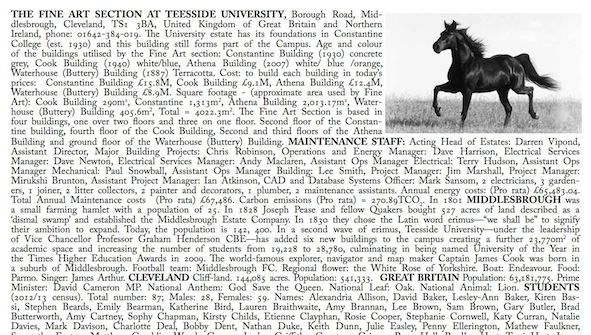
Page 141 2
-

Jaap Blonk, Poet-in-Residence at Shandy Hall
-

Garry Neill Kennedy, Artist-in-Residence at Shandy Hall
-

Freud on Holiday: Appendices III and IV, plus full wrapped set
-

Pigeon Reader
-

Enchiridion: three manoeuvres by Tim Brennan in NE Scotland
-

Do or DIY – exhibition 2
-

Do or DIY – pocketbook
-

Do or DIY – exhibition 1
-

Sucking on Words poetry readings
-

The Man Booker Shortlist Quiz!
-

Reisen II
-

Exercise in Pathetic Criticism
-

The Persons
-

Freud’s Weather
-

Howl #16
-

Have a Peck at Perec, tote bag
-

Frued’s Dining
-

Bibliomancy: Lotsa Fun For All The Family
-

The Forgetting of a Proper Name
-

Summer School for Literary Perverts
-

Poetry Readings in Leeds
-

Instruction Manual
-

information as material residency
-

Re-Writing Freud app
-

Getting Inside Jack Kerouac’s Head
-

Making Nothing Happen DVD
-

The Perverse Library
-

The Perverse Library exhibition
-

Robert Fitterman & Kim Rosenfield Residency
-

Freud and the Gift of Flowers
-

Reisen I
-

THE IDEOLOGY OF DAVID CAMERON’S PARTY
-

Marie-Josée Jean & Klaus Scherübel Residency
-

THE DIE IS CAST
-

He
-

Historico-naturalis et Archaeologica ex Dale Street
-

Craig Dworkin Residency
-

The Voice and Nothing More: an academic mash up
-

Spinning Vol. II: De-Centering the Self
-

A Perverse Library
-

An Agent of the Estate
-

A Disturbance of Memory
-

Iam Survey Exhibition
-

A One Day Bookshop for Experimental Literature
-

Kenneth Goldsmith Residency
-

sucking on words DVD
-

Historia Abscondita (An Index of Joy)
-

L’esprit d’escalier
-

We Report Here
-

Deciphering Human Chromosone 16: Index to the Report
-

Flatland: A Romance of Many Dimensions
-

Reading the Remove of Literature
-

Thesaurus Scienta Lancastriae
-

Freud Dreams of Rome
-

Re-Writing Freud
-

The Answer to the Question
-

Royal Road to the Unconscious
-

bibliomania 2000-2001
-

Interpretation vol.I
-
Interpretation vol. II
-

bibliomania 1998-1999
